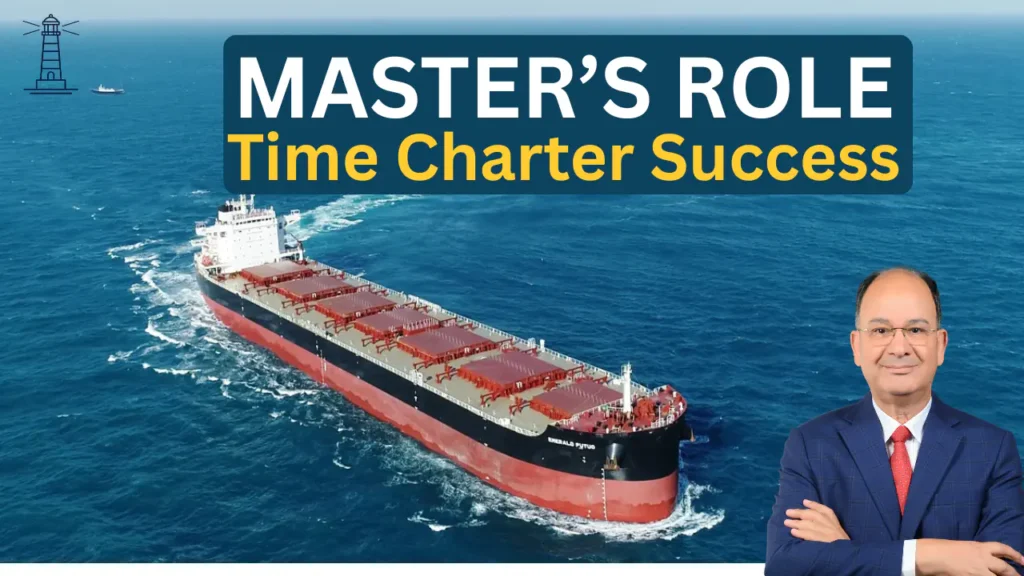
The Ship Master’s Role in Time Charter Success:Avoiding Off-Hire, Claims and Disputes

In time charter operations, disputes rarely arise because of poorly drafted contracts.
They arise because the vessel’s operation is not aligned with the commercial framework of the charterparty.

At the center of this alignment is one key figure: the Ship Master.

The Master is not only responsible for navigation and safety — but also plays a critical role in protecting the commercial performance of the charter.

Why the Master Is Critical in Time Chartering

Under a time charter, the vessel is placed at the charterers’ disposal for a defined period, while the shipowner retains responsibility for the vessel’s management and crew.

This creates a shared operational-commercial structure, where:

  • Charterers control employment and commercial management (voyages, ports, cargo).
  • Owners remain responsible for the vessel and crew (technical management).
  • The Master acts as the link between both sides.

Any misalignment at this level can quickly lead to:

  • Off-hire disputes
  • Performance claims
  • Operational delays
  • Charterparty breaches

The Master’s Core Responsibilities

  • Executing charterers’ voyage instructions (within safe and lawful limits)
  • Ensuring compliance with charterparty terms
  • Maintaining accurate logs and operational records
  • Supervising cargo operations
  • Monitoring vessel performance (speed & consumption)

Failure in any of these areas can have direct legal and financial consequences.

Operational Compliance and Commercial Impact

Small operational decisions can create significant commercial exposure.

  • Deviations may lead to disputes
  • Delays can trigger off-hire claims
  • Cargo issues may cause liability claims

The Master must balance safety, owners’ instructions, and charterers’ orders.

Reporting: A Critical Commercial Function

  • Noon reports
  • Speed & consumption data
  • Statements of Facts
  • Operational records

These documents are the foundation of claims and disputes.

Where Problems Typically Arise

  • Misunderstanding charterparty obligations
  • Poor communication
  • Weak documentation
  • Lack of commercial awareness

Best Practices

  • Clear communication
  • Strict compliance with instructions
  • Accurate reporting
  • Risk awareness

Watch the Full Explanation

Final Insight

Success in time chartering depends not only on the contract — but on its execution in practice.

The Ship Master plays a decisive role in that execution.