In time charter operations, disputes rarely arise because of poorly drafted contracts.
They arise because the vessel’s operation is not aligned with the commercial framework of the charterparty.
At the center of this alignment is one key figure: the Ship Master.
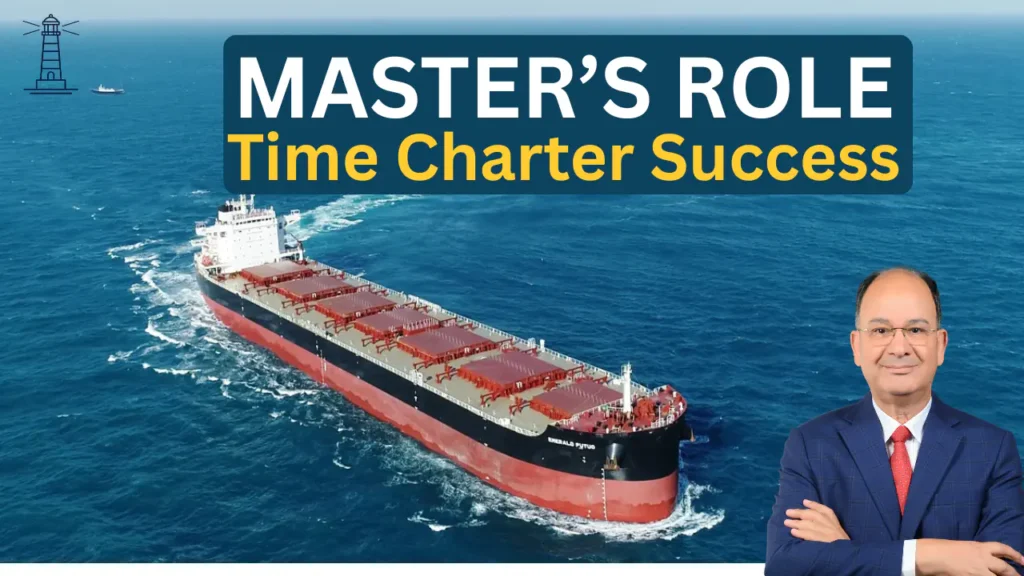
The Master is not only responsible for navigation and safety — but also plays a critical role in protecting the commercial performance of the charter.
Why the Master Is Critical in Time Chartering
Under a time charter, the vessel is placed at the charterers’ disposal for a defined period, while the shipowner retains responsibility for the vessel’s management and crew.
This creates a shared operational-commercial structure, where:
- Charterers control employment and commercial management (voyages, ports, cargo).
- Owners remain responsible for the vessel and crew (technical management).
- The Master acts as the link between both sides
Any misalignment at this level can quickly lead to:
- Off-hire disputes
- Performance claims
- Operational delays
- Charterparty breaches
The Master’s Core Responsibilities
The Master’s role extends beyond safe navigation. It includes ensuring that the vessel operates in full compliance with the charterparty.
Key responsibilities include:
- Executing charterers’ voyage instructions (within safe and lawful limits)
- Ensuring compliance with charterparty terms
- Maintaining accurate logs and operational records
- Supervising cargo operations
- Monitoring vessel performance (speed & consumption)
Failure in any of these areas can have direct legal and financial consequences.
Operational Compliance and Commercial Impact
In practice, small operational decisions can create significant commercial exposure.
For example:
- Deviations from voyage instructions may lead to disputes
- Delays in port operations can trigger off-hire or claims
- Improper cargo handling may result in cargo damage liability
The Master must balance:
- Safety obligations
- Owners’ instructions
- Charterers’ employment orders
This requires not only technical competence — but also commercial awareness.
Reporting: A Critical Commercial Function
Accurate reporting is one of the most important — and often underestimated — aspects of the Master’s role.
This includes:
- Noon reports
- Speed and consumption data
- Statements of Facts
- Cargo and operational records
These documents form the foundation of claims and dispute resolution.
Inaccurate or incomplete reporting can:
- Weaken the owner’s position
- Support charterers’ claims
- Lead to financial losses
Where Problems Typically Arise
Most issues related to the Master’s role are not intentional — they result from lack of alignment or awareness.
Common challenges include:
- Misunderstanding charterparty obligations
- Poor communication with operators and charterers
- Inadequate documentation
- Failure to recognize commercial implications of operational decisions
These gaps often lead to avoidable disputes.
Best Practices for Masters
To support successful time charter performance, Masters should focus on:
- Clear and timely communication with all parties
- Strict compliance with voyage instructions (within safety limits)
- Accurate and consistent reporting
- Awareness of charterparty terms affecting operations
- Proactive identification of potential risks
A commercially aware Master is a key asset in preventing disputes before they arise.
Why This Matters Commercially
The Master’s daily decisions directly affect:
- Hire and off-hire status
- Vessel performance claims
- Charterparty compliance
- Operational efficiency
- Overall profitability of the charter
In many cases, the difference between a successful charter and a dispute lies in how well the Master understands and executes their role.
Watch the Full Explanation
For a structured and practical breakdown of the Master’s role in time chartering:
<iframe width=”560″ height=”315″ src=”https://www.youtube.com/embed/UmsTb2X16R0?si=M85ybyyQV_7ecYUg” title=”YouTube video player” frameborder=”0″ allow=”accelerometer; autoplay; clipboard-write; encrypted-media; gyroscope; picture-in-picture; web-share” referrerpolicy=”strict-origin-when-cross-origin” allowfullscreen></iframe>
Learn How to Bridge the Gap Between Operations and Chartering
These issues are explored in depth through our structured, real-case training designed to bridge the gap between contract wording and operational reality.
Participants gain practical understanding of:
- Time charter operations and responsibilities
- Charterparty clause interpretation
- Risk allocation between owners and charterers
- Claims prevention and dispute management
- Real-world operational scenarios
This is essential knowledge for shipowners, charterers, operators, shipbrokers, and Masters aiming to strengthen their commercial awareness.
Final Insight
In time chartering, success is not determined by the contract alone.
It is determined by how well the contract is executed in practice.
And in that execution, the Ship Master plays a decisive role.