In voyage chartering, few principles create more confusion — and costly disputes — than the rule:
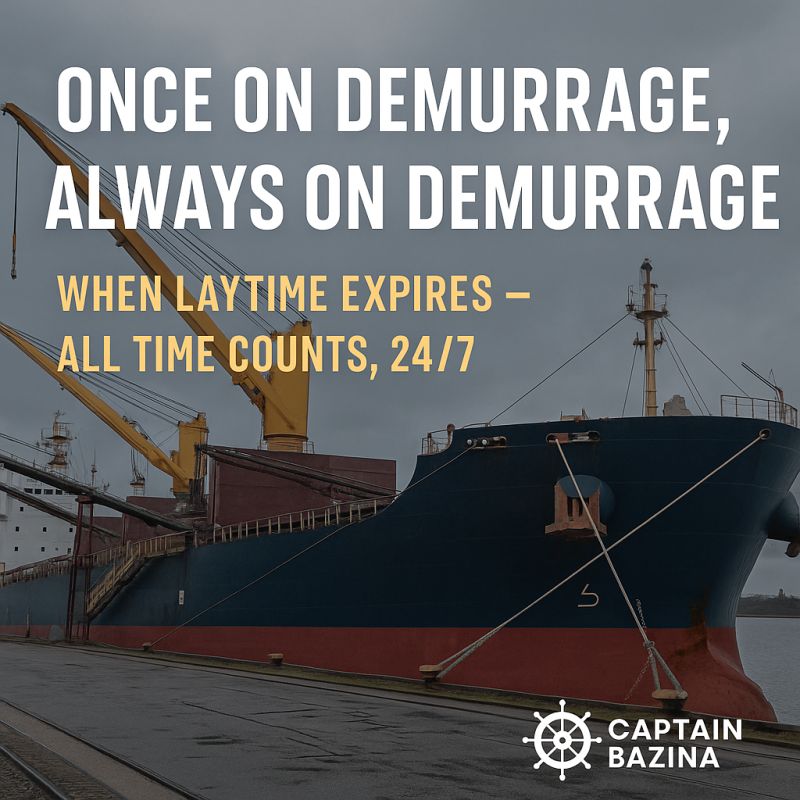
“Once on Demurrage, Always on Demurrage.”
Many charterers are surprised to find a vessel already on demurrage before cargo operations even begin.
This often leads to disputes, financial exposure, and strained commercial relationships.
Understanding how this rule works in practice is essential for anyone involved in chartering.
Why Do Vessels Go on Demurrage So Early?
Under a voyage charterparty, charterers are granted a specific period to complete cargo operations — known as laytime.
If this agreed time is exceeded, the vessel goes on demurrage, and charterers must pay a daily agreed amount for the delay.
However, in many cases — particularly under port charterparties — laytime may start counting before the vessel reaches the berth.
This means:
- Congestion at port does not necessarily stop laytime
- Delays outside the charterers’ direct control may still count
- Laytime can expire before loading or discharging even begins
As a result, the vessel may already be on demurrage upon arrival at berth.
What Does “Once on Demurrage, Always on Demurrage” Mean?
This principle is simple in wording, but significant in impact.
Once laytime has expired and the vessel is on demurrage:
- All time counts continuously
- It runs 24 hours a day, 7 days a week
- Exception clauses no longer apply
This includes common protections such as:
- Weather Working Days (WWD)
- Sundays and Holidays Excluded (SHEX)
- Other laytime interruptions
Unless the charterparty explicitly states otherwise, these exceptions cease to apply once demurrage begins.
Why This Matters Commercially
This rule shifts the risk significantly toward charterers.
What may seem like protected time during laytime suddenly becomes fully chargeable time once demurrage starts.
For example:
- Bad weather no longer stops the clock
- Port closures or holidays do not suspend counting
- Operational delays continue to generate cost
This can lead to rapid cost escalation, especially in congested or inefficient ports.
When Can Demurrage Stop Counting?
Although the rule is strict, it is not absolute.
Demurrage may stop — or not run — if the delay is caused by the shipowner’s fault.
Typical examples include:
- Cargo handling equipment failure (e.g. cranes on bulk/general cargo vessels)
- Pump breakdown on tankers
- Mechanical or operational deficiencies affecting performance
In such cases, the principle is clear:
A party cannot benefit from its own fault.
However, proving this in practice often becomes a matter of evidence, documentation, and clause interpretation.
The Real Source of Disputes
Most demurrage disputes do not arise from calculation errors.
They arise from:
- Misunderstanding when laytime starts
- Incorrect interpretation of charterparty clauses
- Poor documentation (e.g. Statement of Facts)
- Lack of clarity on exceptions and their application
The phrase “Once on Demurrage, Always on Demurrage” is often quoted — but not always properly understood or applied.
Learn How to Avoid Costly Demurrage Mistakes
These issues are explored in depth through our structured, real-case training designed to bridge the gap between contract wording and operational reality.
The program focuses on:
- Laytime calculation and clause interpretation
- Demurrage risk management
- Voyage vs time charter practical differences
- Real dispute scenarios and how to handle them
This is essential knowledge for:
- Shipowners
- Charterers
- Shipbrokers
- Operations professionals
Final Thought
Demurrage is not just a financial mechanism — it is a risk allocation tool.
Understanding when it starts, how it runs, and when it may stop is critical to protecting your commercial position.
Because in chartering, small misunderstandings can quickly turn into significant financial consequences.