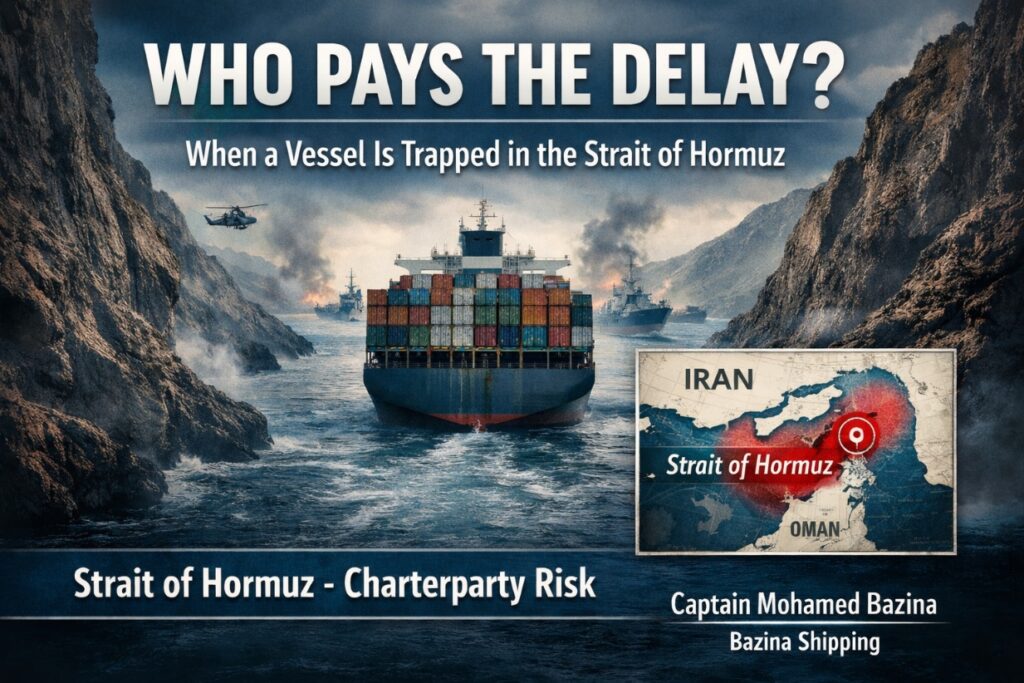
Who Pays the Delay?
The Strait of Hormuz remains one of the most sensitive and strategically critical shipping routes in the world.
The situation in the region is tragic, and our thoughts are with those affected. For shipping and marine insurance professionals, however, such events raise a fundamental commercial question:
Who bears the delay risk?
The Scenario
A vessel is ordered to a port inside the Strait of Hormuz.
- At the time of nomination, the port is considered safe
- The vessel proceeds on that basis
- A sudden geopolitical development leads to the closure of the Strait
- The vessel is already inside
At this point, the issue is no longer operational. It becomes a matter of contractual risk allocation, often involving significant financial exposure under both charterparties and insurance arrangements.
Safe Port Liability
Under English law, charterers are required to nominate a prospectively safe port.
Where:
- The port was safe at the time of nomination; and
- The danger arises subsequently due to geopolitical developments
Charterers will generally not be in breach of the safe port warranty.
The focus therefore shifts away from port safety and towards a more critical question:
How does the charterparty allocate the resulting delay risk?
Time Charter Analysis
Where the vessel becomes trapped inside the Strait under a time charter:
- The vessel remains operational
- The delay arises from external geopolitical restrictions
- There is no inherent deficiency in the vessel itself
In such circumstances, the vessel will typically remain on-hire.
Outcome:
The charterer continues to pay hire for the duration of the delay.
Voyage Charter Analysis
Under a voyage charter, if the vessel is delayed before completing the contracted voyage:
- The voyage is interrupted or prolonged
- Operating costs increase
- Freight is only earned upon successful completion
In many cases, the financial burden of delay falls on the owner, unless the charterparty provides specific protection.
Outcome:
The owner bears the delay risk, absent any contractual mechanism to shift it.
The Decisive Role of War Risk Clauses
In practice, the outcome is often determined by the War Risks Clause, frequently based on BIMCO standard wording.
Such clauses may entitle owners to:
- Refuse to proceed to unsafe areas
- Deviate from the agreed voyage
- Recover additional war risk insurance premiums
However, their effectiveness is highly dependent on timing.
Practical Limitation
Where the vessel is already inside the Strait at the time of closure, the practical value of these protections may be significantly reduced.
At that stage, the situation becomes one of risk already materialised, rather than risk avoided.
Insurance and P&I Considerations
From an insurance perspective, this scenario raises multiple layers of exposure:
- War risk coverage implications
- Delay-related financial losses
- Allocation of liability between owners and charterers
For P&I Clubs and marine insurers, such cases often require careful interpretation of both policy terms and underlying charterparty obligations.
Key Takeaways
If a vessel is trapped inside the Strait of Hormuz following a closure:
- There is no automatic breach of safe port warranty
- Under a time charter, hire will generally continue
- Under a voyage charter, the owner often bears the delay risk
- War risk clauses may influence the outcome, but are not always decisive
Final Perspective
In shipping, risk allocation is rarely determined by the event itself, but by when the event occurs relative to the vessel’s position and contractual commitments.
The distinction between before entry and after entry into a high-risk area can fundamentally alter:
- Legal responsibility
- Financial exposure
- Commercial outcome
Training Insight
Scenarios of this nature are not theoretical. They sit at the core of modern chartering practice, where legal interpretation, commercial judgment, and risk management intersect.
A detailed understanding of:
- Safe port obligations
- Off-hire vs on-hire principles
- War risk clauses and BIMCO frameworks
- Practical case-based applications
is essential for anyone operating in ship chartering, broking, or marine insurance.
These elements are explored in depth through our structured, real-case training designed to bridge the gap between contract wording and operational reality.